Meet Our Founder
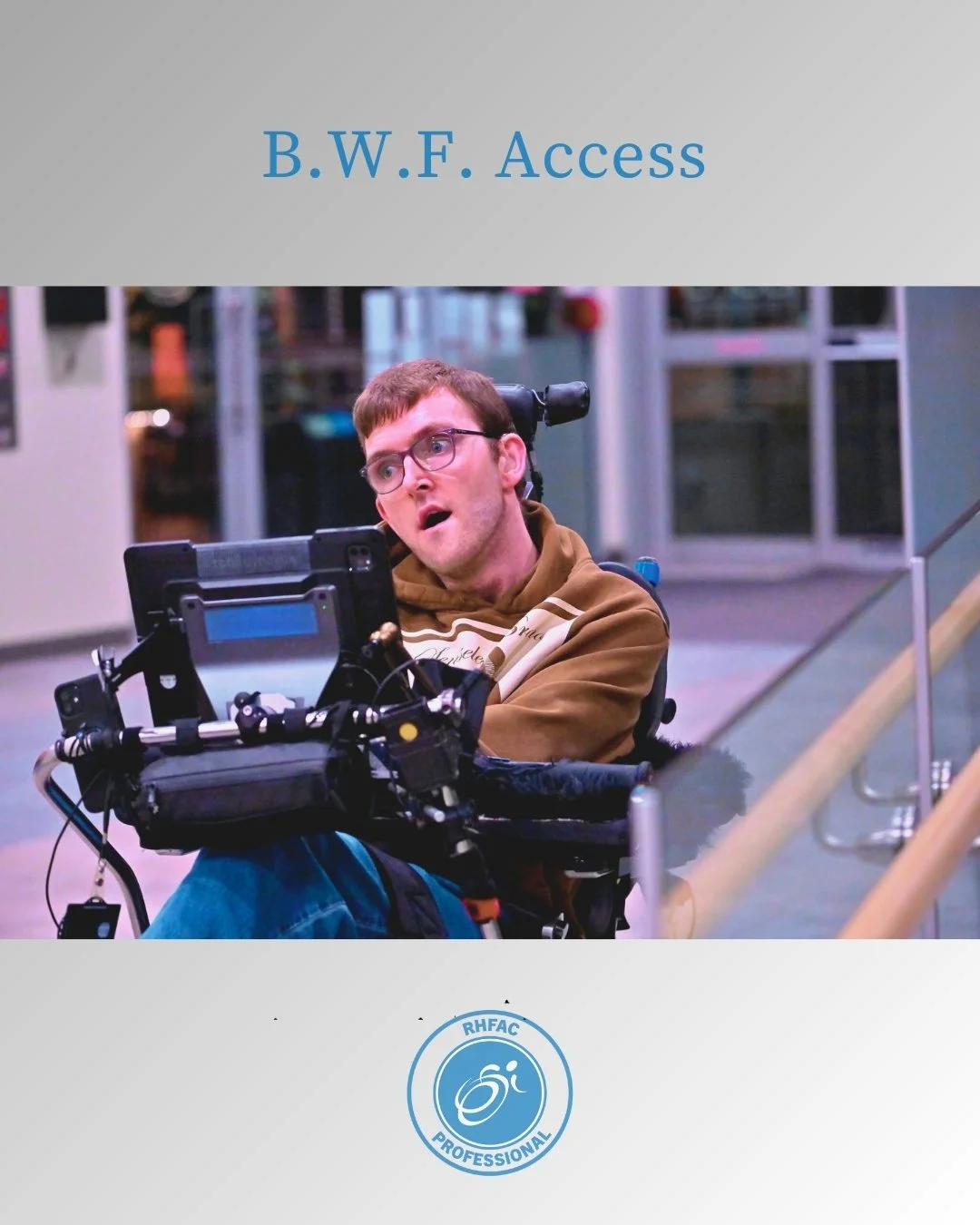
A photo of Ben with our logo and the RHFAC Professional badge
At B.W.F. Access, accessibility consulting is both technical and delved from lived experience.
Ben, founder of B.W.F. Access, lives with quadriplegic Cerebral Palsy and navigates the built environment using a power wheelchair, a speech device, and hearing aids. His daily interaction with physical spaces provides a level of usability insight that cannot be learned from guidelines alone.
When Ben moved from a small town to Vancouver, BC in his early twenties, he encountered a critical truth:
Even in cities, barriers remain — especially in spaces that technically meet code.
One recurring example is elevator control placement.
Many standard elevator panels are positioned high and recessed into corners. For individuals with limited upper-body mobility, this creates functional inaccessibility despite regulatory compliance.
This is not an isolated design flaw. It reflects a broader issue:
Compliance does not always equal usability.
That distinction is central to our work.
Because Ben experiences these gaps firsthand, B.W.F. Access evaluates buildings through two lenses:
• Certified RHFAC standards
• Functional, real-world usability
When assessing a property, we do not simply verify the presence of accessible features. We evaluate how effectively those features perform.
Small design decisions — button placement, door pressure, signage positioning — directly impact independence, navigation efficiency, and customer confidence.
These usability details influence:
• Tenant satisfaction
• Customer retention
• Public reputation
• Long-term retrofit costs
Ben’s lived experience allows him to identify friction points that are often normalized by internal teams. Where others may see “code-compliant,” we ask: Is it usable? Is it intuitive? Does it give independence?
This perspective strengthens the accuracy of our RHFAC assessments and provides clients with clearer, more practical recommendations.
At B.W.F. Access, accessibility is evaluated as asset performance — not abstract compliance.
That difference leads to stronger outcomes.